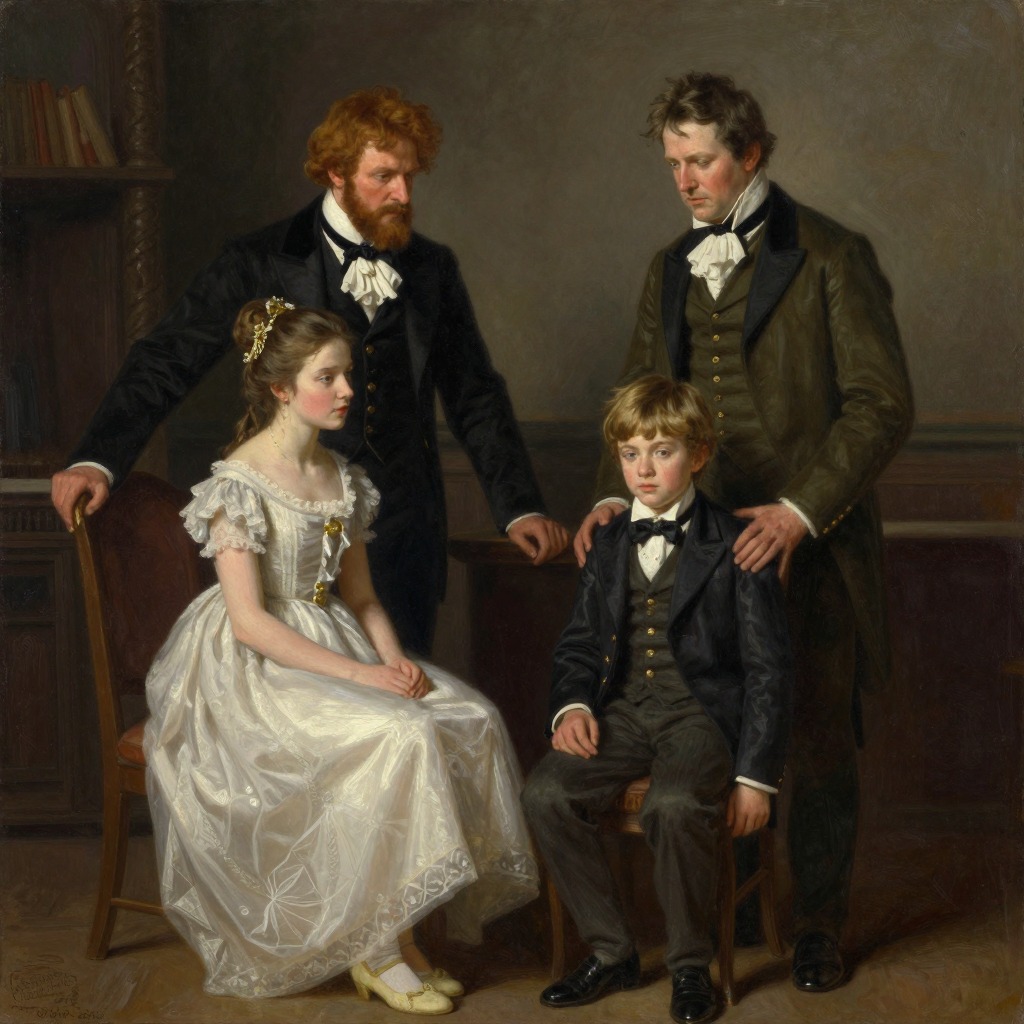
Adelaida Ivanovna Epanchin
Adelaida Ivanovna Epanchin, the middle daughter of General Ivan Fedorovitch Epanchin and Lizabetha Prokofievna, is a young woman of twenty-three whose artistic talent, merry disposition, and capacity for quick sympathy distinguish her among her sisters. She is described as having a very happy face, the most sympathetic of the three, and one that suggests a kind sister who can see into another's heart very quickly. Her role in the novel is that of a steady, affectionate presence who, through her engagement to the honorable Prince S., brings a measure of stability to a family perpetually on the verge of crisis.
Identity and Artistic Temperament
Adelaida is a clever artist, a fact she concealed until lately, and she is constantly in search of a subject for a picture. She fusses among her paints and paint-brushes at the easel, and her family's principal business, as Prince S. remarks, is to find subjects for her pictures. She confesses that she does not know how to see, and asks the prince to help her find a subject, a request that leads him to describe the face of a criminal one minute before the fall of the guillotine. Her artistic sensibility is also evident when she examines the portrait of Nastasia Philipovna and declares, "Such beauty is real power. With such beauty as that one might overthrow the world." This remark reveals her capacity to perceive the dangerous, almost metaphysical force of beauty, a theme central to the novel.
Arc Through the Plot: Engagement and Family Dynamics
Adelaida's engagement to Prince S. is a pivotal event that brings relief to her mother, Lizabetha Prokofievna, who declares, "It will be one off our hands!" The match is both happy and suitable, and Prince S. is a distinguished man of means. This engagement, however, is repeatedly postponed, first to allow the two weddings—Adelaida's and the anticipated wedding of Aglaya and the prince—to come off together, a plan that Aglaya furiously rejects. Adelaida, along with her sisters, is present at the key dramatic scenes of the novel: the prince's first visit, the scandalous confrontation with the "Pavlicheff's son" claimants, and the disastrous evening party where the prince suffers an epileptic fit. Throughout these events, she maintains a composed and often amused demeanor, laughing at the prince's confusion and at her sister Aglaya's antics.
Relationships and Conflict
Adelaida's relationship with her mother is one of affectionate exasperation. She is the one who, when her mother is in a rage, preserves her good temper and spirits, and she is not afraid to tease her. She also has a warm, protective relationship with the prince, whom she kisses on the forehead after his awkward declaration to Aglaya, and she is the first to defend him when her mother is angry. Her engagement to Prince S. is a source of harmony, though there are hints of future tension; Evgenie Pavlovitch later observes that there is not yet perfect harmony between Adelaida and her fiance, but he believes that in time the impulsive young girl will let herself be guided by his reason and experience.
Change and Ending
Adelaida's story concludes with her marriage to Prince S. and a subsequent trip abroad. After the prince's final collapse, she and her family visit him at Dr. Schneider's establishment in Switzerland. There, she and Alexandra are deeply grateful to Evgenie Pavlovitch for his "angelic kindness to the unhappy prince." The family's experience with Aglaya's disastrous marriage to the Polish count has given Adelaida much to think about, and she has become more reflective. Her own marriage, while not without its challenges, represents the most conventional and stable outcome among the Epanchin sisters.
Thematic Significance
Adelaida embodies the novel's theme of art and the perception of beauty. Her search for a subject and her reaction to Nastasia's portrait highlight the power of beauty to both inspire and destroy. She also represents the possibility of a balanced, happy life within the chaotic world of the novel. Her merry, sympathetic nature and her successful marriage provide a counterpoint to the tragic fates of Nastasia Philipovna, Rogojin, and the prince himself, suggesting that not all souls in this world are doomed to be consumed by passion and madness.